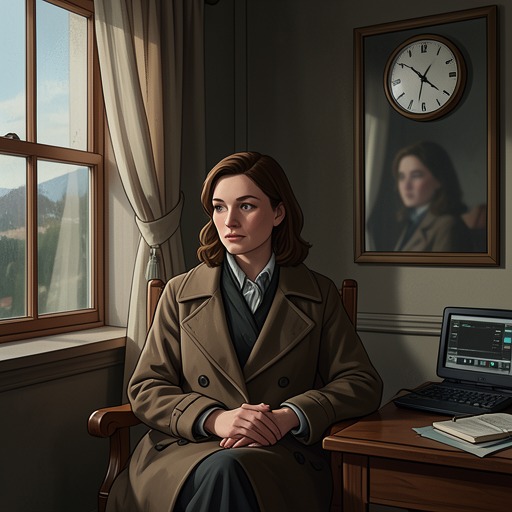
Victoria Bergman
Crow GirlVictoria Bergman is both a person hidden behind the name Sofia Zetterlund and the identity who ultimately reclaims that life. Her history is shaped by severe abuse, dissociation, and the invention of separate selves to endure experiences she could not otherwise bear. As she pieces together diaries, bodily memories, and gaps in her own account, the question shifts from which personality acted to whether she can live without dividing her experience among them.
Identity and Background
Victoria’s life under the name Sofia Zetterlund began as a practical means of survival, but the name was not simply assigned to her. When applying for a protected identity, Victoria expected someone else to select a name along with her new identification number. Instead, the form gave her three boxes for a first name, surname, and optional middle name. She wrote Sofia in the first box, left the second blank, and put Zetterlund in the third. Before the clerk had collected the papers, she was already practising the signature. The identity that would make an ordinary public life possible therefore began in a small act of her own choosing, even as she understood it as the start of a life apart from Victoria.
The difference between the two names also becomes a difference in access to experience. In Sofia’s clinical understanding, Victoria had created versions of herself to survive and manage memories of abuse. One of those selves could study, work, and function in a socially recognisable way; the documents for a new identity gave that conscientious part a basis for living as Sofia Zetterlund. This is Sofia’s explanation of the fragmentation, not proof that every memory can be neatly assigned to a single personality. Victoria’s own account remains unsettled: she forgets what she has said, sometimes within minutes, and wonders whether childhood memories are real, reshaped by later understanding, or expressed through a younger manner of speaking.
Protective Selves and Survival
The different selves answer different needs. Victoria comes to understand that she created the Reptile so that she could eat and sleep when basic needs were being denied to her. Later, she relied on it to make sexual contact possible: it allowed Lars Magnus Pettersson inside and, in another episode, participated in group sex with him at a nightclub in Toronto. She understands this personality as a kind of imagined libido, not as her own uncomplicated desire. The distinction matters when she recalls sleeping with Jeanette Kihlberg. She is sure the Reptile was not present, and the recognition brings her intense happiness: the experience could belong to her without being delegated to an alter.
Other names mark other forms of division. Victoria lists Gao Lian, Solace Manuti, the Worker, the Analyst, the Moaning Minnie, the Reptile, the Sleepwalker, and Crow Girl among the identities or characteristics from which she has kept herself at a distance. Crow Girl, in her own account, is a composite of the others, except for the Sleepwalker, who does not know Crow Girl exists. These distinctions help explain how she has endured, but they also make her own actions difficult to recognise. Her question about whether the Reptile might have killed someone remains open at first; when she later revisits her memory of Samuel Bai, however, she concludes that she did not attack him with a hammer. She remembers throwing him out after he began pawing at her. The correction restores a particular action to her own account without resolving every uncertainty about the past.
Recovering a Life from Fragments
Victoria’s recovery is piecemeal. She sorts through sketches, notes, and newspaper clippings in the hidden room that had once held Gao Lian, trying to arrange materials she recognises but still doubts. Reconstructed together, they form a life that was hers, even if it has felt like someone else’s. She remembers that medication and alcohol once kept unpleasant memories suppressed, as though parts of herself had been hidden beneath her skin. When the memories briefly become clear, she cannot tell how long that clarity will last.
Her diary from Sigtuna boarding school gives that recovered life a chronology of its own: two years of torment, bullying, and mental cruelty. Revenge and retribution recur in its pages, alongside a fantasy of returning to destroy the school. By the time she rereads those entries, two people mentioned in them are dead, but she knows she had nothing to do with their deaths. The contrast between the diary’s violent wishes and her knowledge of what she did not do makes the archive more than a record of grievance; it is a way to distinguish remembered rage from responsibility for later events.
Memory also returns through disruptions in the present. After waking on the living-room floor with no certainty whether it is morning or evening, Sofia finds a childish message written on the mirror. She recognises Solace Manuti’s jagged handwriting and understands the words as a plea for help in Krio. The message makes an otherwise hidden part of the household’s inner life visible, while Sofia’s uncertainty about the time and the abrupt awakening show how little control she has over the transitions between states.
The body supplies evidence where memory fails. During an examination, Victoria closes her eyes while a clinician records extensive injuries and scarring, including damage consistent with forced dilation when she was very young. She thinks of undergoing the examination as a way to begin again, become someone else, and forget. The wish captures the bargain at the heart of her divided identity: another self might make life bearable, but that relief can also keep the person who was harmed from knowing her own history.
Relationships and Reappearing Pasts
Victoria’s dissociation affects her connections with other people, including her relationship with Jeanette Kihlberg. In one call, Sofia makes the call and Victoria ends it; unusually, Victoria remembers every word. She lies to Jeanette that she is waiting for a client at the practice, while Sofia knows about the lie and encourages it. The deception is shared rather than attributed to one personality alone, a small but important sign that the boundary between them is changing.
Her past also returns as a physical encounter with her daughter, Madeleine Silfverberg. At the Klippgatan stairs, Victoria follows an old woman she believes to be her dead mother and insists that they must talk. Across the street, Madeleine sees Victoria, huddled and apparently cold, as the woman who is her mother. The scene brings the two women into the same place without making their histories easy to resolve: Victoria approaches carrying memories of death and unanswered questions, while Madeleine recognises the parent she has been searching for.
Victoria’s awareness of her concealed history is inseparable from the records that document it. Passing a server farm in a cavern beneath Sofia Church, she knows that the protected systems preserve digitised information belonging to Swedish authorities, including confidential files about both Sofia Zetterlund and Victoria Bergman. Public records preserve the split even as Victoria tries to understand it from within. In private, she works through her papers; beyond her, the state’s files hold another version of the same divided identity.
Integration and Ending
As Victoria becomes more able to control the transitions between identities, she describes the change not as the disappearance of every trace of the past but as a new closeness between the selves. Her recollection of the shared call with Jeanette is one measure of that progress. Another is the recognition that the Reptile was absent from her intimacy with Jeanette. These moments allow her to experience feeling and choice as hers, rather than as actions assigned to an unknown part of herself.
She also recalls what the Sleepwalker’s periods of control looked like: memory lapses, nocturnal walks, visits to bars, and drunken wandering through dark parks. On one occasion she went to the Clarion Hotel, had sex with a man in his room, then walked to the water with two bottles of wine and fell in near Norra Hammarbyhamnen. Previously, the episode had left Sofia trying to work out what had happened. Victoria now remembers it as part of her own life, rather than an inexplicable blank belonging to someone else. She understands the Sleepwalker to be dead and herself to be the one making decisions, feeling, and acting; she reports that the lapses and nocturnal episodes have stopped.
The final movement of her arc is a refusal to keep naming parts of herself as separate people. Victoria decides not to distance herself from her being by inventing other selves, and to stop letting unknown parts handle what she finds difficult. From then on, what happens is to Victoria Bergman, not to someone else. Looking at her reflection, she recognises herself rather than the cowed face associated with Sofia in control. The recognition does not erase the abuse or restore an untouched past. It marks a change in how she carries it: the memories and consequences can belong to one person, who can acknowledge them without treating every painful response as a stranger.
Narrative Significance
Victoria’s arc makes the novel’s identity mystery a question of survival as well as concealed history. Names and personalities first function as compartments: one can endure what another cannot remember, and a protected identity can give a functioning self a documented place in the world. But the same divisions complicate agency, memory, and guilt. Victoria’s review of the Samuel Bai episode demonstrates why reconstruction matters: recovering a memory can correct a false account of an action, even when it does not resolve every uncertainty.
The narrative gives that reconstruction material form in the diary, annotations, medical examination, government files, and the hidden room’s accumulated papers. Each offers a different kind of evidence, none sufficient alone. Victoria’s identity becomes more coherent not because the fragments vanish, but because she can recognise the fragments as parts of her own life. Her ending therefore turns integration into an ethical as well as psychological change: she no longer assigns difficult experiences to invented selves, and she accepts that the person who survives is also the person to whom the past happened.